Every winter, we rely on our heaters for warmth. A cold floor can draw heat from your feet, and radiant floor heating can make the surface more comfortable.
For that reason, this article will educate you on insulation importance and the best insulation for radiant floor heat.
Radiant floor heating performance depends on the building’s heat loss, the floor assembly, the heating output and the controls. Insulation is one part of that design.
Suitable insulation reduces unwanted heat flow below the heated floor. Choose it for the complete assembly rather than assuming that any thin insulating roll will do the same job.
Heating mats and hydronic tubing are heating components, not insulation. The sections below distinguish these components from the insulation used with them.
Understanding Radiant Floor Heat System
Radiant floor heat system has an option of electric cables, water pipes, or warm air passages that run beneath or on the floor to heat the floor surface.
Heat conducts through the floor covering from the heating elements or tubing. The warm surface then exchanges heat with the room by radiation and convection.
Radiation warms surrounding surfaces and occupants, while convection transfers heat to air moving over the floor.
What Are the Types of Radiant Floor Heating Systems?
Before you learn about insulation methods, it’s good to understand the three types of radiant floor heat systems. Let’s dive in;
1. Air Based Radiant Floor Heating System
Air-based systems move heated air through passages in the floor. Air has limited heat-storage capacity, so this approach is less common in homes than electric or hydronic floor heating.
An electric heating mat is not an air-based system. Its installation requirements belong in the electric section below.
Read: Underlay for vinyl flooring
2. Electric Radiant Floor Heating System
An electric radiant floor heating system uses resistance cables or mats approved for a particular floor assembly. These can provide local floor warming, such as in a bathroom, but the floor covering and installation method must match the product instructions.
Operating cost depends on electricity rates, the heated area, the building’s heat loss and how the system is controlled.
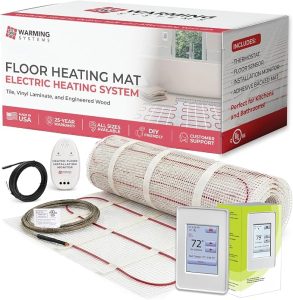
The Warming Systems 15-square-foot, 120V mat is an electric floor-heating example. Its mat measures 20 inches by 9 feet and draws 180W (1.5A). The kit includes a UDG4-4999 touchscreen thermostat with a floor sensor and Class A GFCI protection. It is a heating kit, not an insulation layer.