
An uninsulated garage is the worst space to work in, particularly in the cold season. If you’ve dangled like a leaf or seen your breathe because the inside of the garage is extremely chilly, then you have the experience of how unbearable it can be to keep going.
But you shouldn’t abandon your projects simply because it’s cold. You can use the best heater for uninsulated garage to make the rather cold space comfortable to work in.
Choose a heater for your garage’s electrical supply, installation space and heat loss; a drafty building may need insulation as well as supplemental heat.
With that said, here are some of the best heaters to consider if you work in an uninsulated garage.
- Comfort Zone CZ220 5000W Ceiling Mount Heater
- Dr. Infrared Heater DR-238 Mounted Infrared Heater
- Dr. Infrared Heater DR-988 Heater


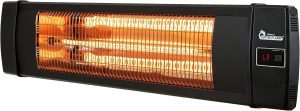
Dr. Infrared Heater DR-238 120V 1500W Mounted Infrared Heater
- Mounted carbon infrared heater; 120V supply
- 900, 1200 and 1500W heat settings; remote control
- No room-temperature thermostat
- Targeted supplemental heat; check mounting height and clearances
Best Heater for Uninsulated Garage Reviewed
1. Dr. Infrared Heater DR-988 Heater
The DR-988 is a portable industrial fan-forced electric heater. Its brand name, Dr. Infrared Heater, should not be confused with the heating system used in other models.
It is rated at 5,600 watts on 240V, rather than the dual-heating arrangement of the DR-968. It is not a standard 120V household plug-in heater.
The adjustable thermostat is specified from 37°F to 113°F. Its setting controls cycling; it does not guarantee that a draughty garage will reach that temperature.
The manual requires a dedicated 240V, 30A circuit and the matching grounded NEMA 6-30R receptacle for its NEMA 6-30P plug. Connect it directly, without an adapter, extension cord or power strip; have an electrician confirm the supply.
Overheat cut-off protection does not make unsuitable locations safe. The manual excludes household heating and areas where gasoline, paint or flammable liquids are used or stored.
There is a mounting discrepancy: the current manufacturer webpage advertises wall/ceiling mounting, while its linked DR-988 manual specifies floor use only. Follow the manual for the exact supplied version and obtain manufacturer confirmation before any other mounting arrangement.
Pros
- 5,600W output on the specified 240V supply
- Adjustable thermostat and carry handle
Cons
- Requires a dedicated compatible circuit and receptacle
- Industrial-use and mounting restrictions must be checked before purchase
2. Dr. Infrared Heater DR-238 Mounted Infrared Heater
The DR-238 offers targeted infrared warmth from a mounted 120V heater. It is an option for the occupied work area of a suitable garage, rather than a promise to heat the entire uninsulated building.
Dr. Infrared Heater DR-238 120V 1500W Mounted Infrared Heater
- Mounted carbon infrared heater; 120V supply
- 900, 1200 and 1500W heat settings; remote control
- No room-temperature thermostat
- Targeted supplemental heat; check mounting height and clearances
Its carbon element has three power settings: 900, 1200 and 1500 watts. The supplied remote selects the heat level and timer; this version does not have a room-temperature thermostat.
Wall and ceiling brackets are supplied. Check the installation before buying: the current manufacturer manual requires the lowest point of the heater to be at least 2.4 m (94.5 in) above the floor, as well as the stated ceiling, wall and front clearances. It may not fit a garage with a low ceiling.
The heater must connect directly to a suitable grounded wall outlet. Do not use it where gasoline, paint or other flammable liquids are used or stored. Follow the manual supplied with the exact unit for installation and operation.
Infrared heat warms people and surfaces in its path. Insulation, drafts and the distance from the heater affect comfort, so no fixed garage coverage or electricity saving is promised here.
What is a hydraulic bottle jack used for?
Pros
- Three heat levels and remote control
- Wall or ceiling mounting leaves floor space clear
- 120V supply, subject to the manual’s electrical requirements
Cons
- No room-temperature thermostat
- Requires substantial mounting height and clearances
- Targeted supplemental warmth rather than guaranteed whole-garage heating
3. Comfort Zone CZ220 5000W Ceiling Mount Heater
The Comfort Zone CZ220 is a ceiling-mounted, fan-forced electric utility heater. It frees floor space but requires a permanent hardwired installation, so it is not a portable plug-in alternative.
Its nominal 240V heat settings are 3,000, 4,000 and 5,000 watts. Have a qualified electrician match the circuit, wiring and installation to the unit label, manual and local electrical codes.
The heavy-gauge steel housing is intended for dry indoor use; it does not make the heater weatherproof or suitable for a damp garage.
The manufacturer excludes hazardous locations, gasoline, paint, flammable liquids and combustible dust. Check those restrictions against how your garage is used.
Separate controls select the heat setting and thermostat level. Temperature cycling helps maintain a chosen setting but cannot overcome unlimited heat loss.
The mounting bracket and louvers allow directed airflow within the manual’s installation limits. Maintain its floor, ceiling, wall and combustible-material clearances; do not direct heat into an obstruction or close the louvers during operation.
A high-limit thermal cut-out stops heating during an overheat condition. If it operates, switch off the power and address the cause as instructed before using the heater again.
Installation needs a suitable structural fixing and grounded hardwired supply. Include that work in the total cost rather than treating this as an easy plug-in installation.
Water pipeline cleaning methods
Pros
- Ceiling mounting leaves floor space available
- Three heat settings and adjustable thermostat
- Directional airflow within the prescribed mounting limits
Cons
- Hardwiring and structural installation are required
- Unsuitable for wet or hazardous workshop conditions
Choose among these options according to your garage and the type of warming you need; check the model’s installation requirements before buying.
Heat loss and the conditions in your garage determine whether supplemental heat will be sufficient.