
A 15,000 BTU air conditioner needs a generator sized for its electrical demand, especially the compressor’s starting load. BTU measures cooling capacity; it does not identify the exact watts or starting current required. Check the air conditioner’s specifications and the other equipment you intend to power before choosing a generator.
A Generator to Consider for a 15,000 BTU Air Conditioner
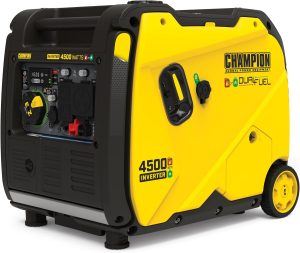
Champion 201319 Dual Fuel Inverter Generator
- Gasoline: 4,500 starting watts and 3,500 running watts
- Propane: 4,500 starting watts and 3,150 running watts
- 120 V output with an RV-ready TT-30R receptacle
- Electric and recoil starting; CO Shield automatic shutoff
The Champion 201319 is a candidate for compatible RV air conditioners when the actual startup demand and combined running load fall within its ratings. The 4,500-watt figure is starting capacity, not continuous output. Propane provides less running capacity than gasoline, so calculate the load for the fuel you will use.
The manufacturer specifies inverter output with less than 3% total harmonic distortion. For background on supplying electronic equipment, consider both power quality and the equipment’s electrical requirements. An inverter does not remove the need to check capacity or connection compatibility.
The unit weighs 99.2 lb and has wheels and a folding handle. Published fuel runtimes are measured at 25% load; they do not predict how long your air conditioner will run. Champion’s 61 dBA rating is measured at 23 feet, so campsite restrictions and placement still matter. See the exact model specifications before ordering.
How Much Generator Power Do You Need?
- Find the air conditioner’s voltage, running load and startup requirements in its documentation. Ask its manufacturer if the starting demand is not specified.
- Add the running demand of equipment that will operate at the same time, including chargers, refrigerators and other RV appliances.
- Allow for the air conditioner starting while those other loads are already running. Do not size only from its normal running watts.
- Check output limits for the selected fuel, operating conditions and the particular receptacle. A 30-amp socket does not make every load combination suitable.
A guide to 15,000 BTU air conditioners can help compare cooling equipment, but the specific unit’s electrical information must govern generator sizing. If a compatible soft-start device is fitted, use its documented requirements rather than assuming a fixed reduction for every compressor.
Fuel, Portability and Setup
Choose between gasoline and propane based on storage, fuel availability and the required running output. Follow the generator’s oil-fill, battery, fuel and first-start instructions. Do not assume a newly delivered generator is ready to run immediately.
Use properly rated cables and the connection method specified for the RV or appliance. Never backfeed household wiring through a wall outlet. A home electrical connection needs approved transfer equipment installed for the application.
Where to Operate the Generator
Operate a fuel-powered generator outdoors, away from doors, windows and air intakes, with exhaust directed away from people and occupied spaces. Never run it inside a home, RV, garage or shed, even with openings or fans. Follow the model’s required placement clearances and local rules.
CO Shield is an additional protective feature, not permission to operate indoors or close to an occupied RV. Keep working carbon-monoxide alarms in occupied spaces and follow Champion’s generator safety guidance. Stop the engine and let it cool before refueling; keep the generator dry using only arrangements permitted by its instructions.
Before You Buy
The Champion 201319 offers a practical dual-fuel option when your measured or documented loads fit its limits. Confirm startup capacity, continuous output, outlet compatibility and campsite rules first. Choose more capacity or a different arrangement if those checks do not support your air conditioner and other loads.