
As most people know, a garden hose is a must-have for watering the yard and garden in the summer and rinsing off the car after a camping trip.
However, garden hoses are often subject to wear and tear over time. Either the pipe, nozzle or connectors may malfunction, resulting in leakages. This is inconvenient, especially if you rely on the hose to water your lawn and the entire backyard hence this guide on how to fix garden hose spray nozzle.
A damaged hose may need a correctly sized hose mender or a replacement coupling. Thread-sealing tape does not repair a split hose or a cracked nozzle body. For a leaking nozzle, first identify whether water escapes at the hose connection, the trigger or the body.
Debris and a worn or missing hose washer are worth checking before replacing the nozzle. Internal valve repairs depend on the model and the availability of suitable replacement parts.
Luckily, you don’t have to hassle as much as in this article; we simplify your things. Keep reading to learn how to fix garden hose spray nozzle problems.
If the nozzle itself needs replacing, these three hose-end options offer different controls and spray patterns. All three use a standard US 3/4-inch garden-hose connection; they are not pressure-washer spray guns.
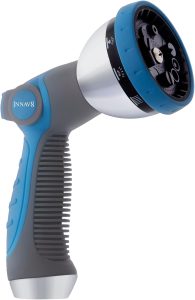
INNAV8 10-Pattern Thumb-Control Hose Nozzle
- Thumb control for water flow and on/off.
- Rotating head with 10 spray patterns.
- Rubberized grip; standard US 3/4-inch hose connection.
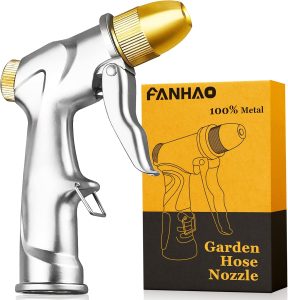
FANHAO Metal 4-Pattern Hose Nozzle
- Metal body with a rotating four-pattern nozzle.
- Trigger control with a hold-open locking bar.
- Standard US 3/4-inch garden-hose connection.
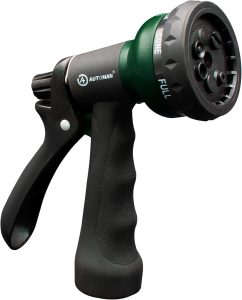
AUTOMAN 7-Pattern Garden Hose Nozzle
- Seven selectable spray patterns.
- ABS body with a rubberized grip.
- Trigger locking bar; standard US 3/4-inch hose connection.
How To Fix Garden Hose Spray Nozzle

1. Turn Off the Water
Turn off the outdoor faucet, then open the nozzle to release the water pressure remaining in the hose. Once the pressure is relieved, disconnect the nozzle. There is normally no need to shut off water to the whole house for this check.
Keep the water supply off while inspecting parts. When you reconnect the nozzle for a test, start with a low flow and check where any leak appears.
2. Adjust the Spray Nozzle
Check the controls intended for your nozzle: a pattern dial, rotating tip, trigger or thumb lever. Move a pattern dial fully into its selected position. Do not assume that an exposed screw is a spray adjustment or loosen body fasteners without the model’s instructions.
Reconnect and test the selected setting at low flow. Poor flow does not by itself prove the nozzle is broken: also check that the faucet is open, the hose is not kinked, and the inlet is clear. Turn off the faucet and release pressure again before further inspection.
Related equipment: Our pressure-washer hose repair guide covers different, high-pressure equipment; its fittings and repair methods are not interchangeable with a garden-hose nozzle.

3. Inspect the Hose Connection and Washer
If water leaks where the hose screws into the nozzle, inspect the washer inside the female inlet. Replace a missing, flattened or cracked washer with the correct size and type, and remove grit from the mating surfaces.
Start the threads straight and tighten the connection by hand, following the nozzle’s instructions. Do not force a cross-threaded connection or use a wrench on the nozzle body. A crack in the inlet or body requires replacement rather than extra tightening.
4. Cleaning the Spray Nozzle
With the water off and pressure released, rinse loose dirt from the disconnected nozzle’s inlet and spray face. Use a soft brush on accessible deposits. Remove an inlet screen only if the model’s instructions permit it.
For mineral deposits, use only a cleaner, concentration and contact time approved for that nozzle’s materials and seals. An overnight vinegar soak is not suitable advice for every model. Do not enlarge or scrape spray holes with a nail file or other metal tool.
Inspect accessible seals for damage. Replace an internal O-ring only when the nozzle is designed to be serviced and a correctly specified part is available. A sealed valve should not be dismantled on the assumption that every nozzle uses the same repair method.
Reassemble any serviceable parts in the order specified by the manufacturer. Reconnect, turn on a low flow and test the spray and shutoff. If water still escapes through a cracked body or a valve that cannot be serviced, replace the nozzle.
Read: Garden hose storage hacks

5. Check the Seal Instead of Adding Tape
A standard garden-hose connection seals against the washer inside the female fitting. Its straight hose threads hold the parts together; they do not seal in the same way as tapered pipe threads.
PTFE thread tape is not a substitute for a sound washer at this connection. Check the washer, mating surface and threads, and replace a damaged coupling or nozzle rather than trying to cover a crack with tape.
For a split in the hose itself, use a hose mender suited to the hose’s size and construction, or replace the hose if the damage is extensive. Do not rely on plumber’s tape as a pressure-bearing patch.
Read: Garden hose leaking at connection
6. Replace a Nozzle That Cannot Be Repaired
If the body or coupling is cracked, or an internal valve fails and suitable service parts are unavailable, replace the nozzle. A worn hose washer alone does not require replacing the whole nozzle or hose.
Choose the control style and spray patterns you need, and check the connection against your hose. The three options above differ in their thumb or trigger controls and in the number of patterns.
Look for the manufacturer’s model information on the nozzle or packaging before ordering parts. Follow its pressure limits and care instructions; a listing that describes “high pressure” does not make a hose nozzle suitable for a pressure washer.
After use, turn off the faucet, release the remaining pressure and drain the nozzle as directed. Store it where freezing water cannot damage the body or seals.
Bottom Line
After a repair, test the connection, spray settings and shutoff at a low flow. Address continuing leaks before using the nozzle normally. For everyday watering, the EPA offers water-saving tips; you can also browse our other home and garden guides.
A clean inlet or a replacement washer may solve the problem. Cracked parts and non-serviceable failed valves call for replacement, not tighter screws or tape. If you cannot identify the correct part, ask the manufacturer before dismantling the nozzle.
Read: Air compressor spray gun for fence painting