
A hybrid table saw is worth considering when you want a stationary workshop saw with a substantial table and induction motor, without necessarily moving to a large, high-powered cabinet saw. The term describes a design category, not a guarantee of cutting quality or safety. Compare the exact model, power supply and space requirements.
For a value-focused shortlist, the Shop Fox W1837 is a genuine open-stand hybrid model. Its suitability depends on your stock sizes, available circuit, dust collection and ability to install and align a heavy machine. Include delivery and setup in the budget rather than comparing only advertised prices.
Shop Fox W1837: A 10-Inch Hybrid Table Saw
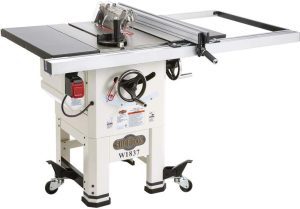
Shop Fox W1837 10-Inch Hybrid Table Saw
- 2 HP induction motor; prewired for 120V
- Manufacturer specifies a 20A circuit at 120V
- Cast-iron main table with steel extension wings
- 30-inch right rip capacity and 4-inch dust port
- Built-in mobile base for workshop positioning
The W1837 combines a cast-iron main table and trunnions with a steel cabinet section and open stand. Its 2 HP induction motor drives a 10-inch blade. The manufacturer specifies 30 inches of rip capacity to the right and 15 inches to the left with the supplied fence and rails. These measurements describe the fence range, not a promise that large sheets can be handled without additional support.
The saw comes prewired for 120V and requires a 20A circuit in that configuration. It can also be configured for 240V according to the manufacturer’s instructions, but conversion is electrical work rather than a plug-and-play voltage switch. Have the supply and any conversion checked by a qualified person; do not assume that any garage outlet is suitable.
A built-in mobile base helps reposition the saw on an appropriate workshop floor. It does not make this a lightweight jobsite saw. Plan the delivery route, lifting arrangements and operating space before ordering, and secure the machine for use as instructed. Leave room for both the incoming board and the finished cut.
What You Get—and What Still Needs Setup
The W1837 includes a blade guard assembly, riving knife, miter gauge and push stick. Its enclosed upper stand has a four-inch dust port for connection to suitable extraction. The port alone does not collect dust, and the main cast-iron table should not be confused with the steel extension wings.
The manufacturer’s W1837 manual covers assembly, electrical configuration, alignment and operating procedures. Check the manual and supplied parts for your machine’s production revision. Table, blade, fence and riving-knife alignment require attention before cutting; a new saw is not automatically ready for accurate work straight out of the shipping crate.
- Useful features: a stationary hybrid layout, induction motor, sizeable rip capacity and built-in workshop mobility.
- Costs to allow for: freight, unloading, extraction, suitable blades and any electrical work.
- Limitations: substantial weight and floor-space needs; the mobile base is not a substitute for safe material support or careful setup.
For context on the category, this older Delta hybrid-saw discussion describes a different machine. Its details should not be treated as W1837 specifications. Our cabinet table saw guide also covers a separate buying category.
Features to Consider When Choosing a Hybrid Table Saw
Power and Cutting Capacity
Match the saw to the thickness and type of wood you normally cut. Blade choice, feed rate, alignment and support affect results as well as motor power. No single blade or horsepower rating means that a saw will cut every wood or material without difficulty. Follow the permitted materials and blade specifications in the manual.
Rip capacity is especially important for wider stock, but also measure the complete fence rails and the space needed around them. A narrow cabinet footprint does not describe the machine’s full operating area. Large panels may be more manageable with a different breakdown method before bringing smaller pieces to the table saw.
Fence, Table and Drive System
Look for a fence that can be aligned and locked consistently, a flat supported table and accessible adjustment instructions. Reviews can identify recurring ownership concerns, but they cannot verify the alignment of the particular saw you receive. Inspect and adjust the machine using the manufacturer’s procedure.
Belt drive is a design feature, not proof that slippage or power loss cannot occur. Keep the drive and adjustments maintained as instructed. For a separate stock-preparation task, see our stationary thickness planer guide.
Dust Collection and Guarding
Choose extraction that meets the saw’s requirements, with an appropriate hose and collection system. A four-inch connection is useful, but it does not guarantee a dust-free workshop. Use the protective equipment and ventilation measures specified for the task.
A guard, riving knife and anti-kickback devices reduce particular risks when correctly installed and used; they do not eliminate kickback or contact injuries. Use the guard for operations where the manual requires it, support the stock properly and keep hands away from the cutting path. Never use the rip fence and miter gauge together in a way that traps the workpiece.
A suitable table saw featherboard can support a particular setup, but its position and use must suit the operation. It is not a replacement for a guard, riving knife or push device.
Assembly, Space and Total Cost
Read the assembly and lifting instructions before the machine arrives. Arrange appropriate help or professional setup if you cannot safely unload, assemble and align it. Choose a stable location with adequate lighting, access to the stop control and room for material handling.
Compare the complete delivered cost with the equipment you already own. A lower purchase price can be offset by freight, electrical changes or missing accessories. Our budget hybrid table saw guide is another starting point, but its price category should not be assumed to describe a current offer.
Final Choice
The Shop Fox W1837 is a relevant hybrid option for a properly equipped home workshop. Confirm the exact model, included components, seller terms and installation needs before buying. Choose it for a suitable cutting workflow and workspace, not because any saw can guarantee safety or perfect results.
For computer-controlled woodworking rather than table-saw cutting, see our CNC machine guide.