
Used to tighten and remove nuts and bolts, impact wrenches are useful for commercial and DIY projects. Pneumatic models need compressed air; cordless and corded electric impact wrenches do not.
The right compressor depends on your wrench’s air consumption at its required operating pressure and how often you pull the trigger. Compare those requirements with the compressor’s delivered airflow and duty-cycle instructions. Tank capacity alone does not establish compatibility.
In this guide, we compare three portable compressors. Their airflow ratings and maintenance requirements differ. They are not universal choices for sustained impact-wrench use: a tool that needs more air can exhaust the stored supply and require recovery time.
Readable gauges, suitable couplers and maintenance requirements also matter. A lower noise rating can improve working comfort, but it does not increase airflow or remove the need for hearing protection specified by the manufacturer.
The models below differ in tank size, airflow and pump lubrication:
- Makita MAC2400: 4.2-gallon twin tank; 4.2 CFM at 90 PSI.
- PORTER-CABLE C2002: 6-gallon pancake tank; 2.6 SCFM at 90 PSI.
- Ingersoll Rand P1IU-A9: 4-gallon twin tank; oil-lubricated pump.

The Makita summary card is followed by details of all three models below.
Best Air Compressor for Impact Wrench Reviews
1. Makita MAC2400 Big Bore Air Compressor
The MAC2400 is an electric compressor with an oil-lubricated pump and a cast-iron cylinder. Its roll-cage construction protects the assembly, but it does not make the unit suitable for every environment.
The twin tanks hold 4.2 gallons, less than the C2002’s 6 gallons. Makita specifies 4.2 CFM at 90 PSI and a maximum pressure of 130 PSI. Check your impact wrench’s air demand rather than treating the tank as a continuous supply.
Makita lists 2.5 maximum HP and 2.1 running HP. The low starting-current design helps reduce startup breaker trips; it is not a guarantee that a circuit can never trip. Follow the manual’s electrical-supply requirements.
Oil lubricates the compressor pump. Check the oil level and follow the prescribed maintenance schedule; the manual calls for oil changes every 300 operating hours or three months, whichever comes first.
At 77 pounds, the MAC2400 is a substantial portable unit. Plan how you will move and position it, and follow the manual before servicing or draining it.
Impact wrenches for changing tires
Pros
- 4.2 CFM at 90 PSI for comparison with your tool’s requirements
- Cast-iron cylinder and protective roll cage
- Oil sight glass for checking lubricant level
Cons
- 77-pound unit requires care when moving
- Oil checks and changes are required
- Air output may be insufficient for a high-consumption impact wrench
2. PORTER-CABLE C2002 Air Compressor
The C2002 is a 120V electric compressor with a 6-gallon pancake tank and an oil-free pump. It avoids pump oil changes, but tank drainage and other maintenance in its manual still apply.
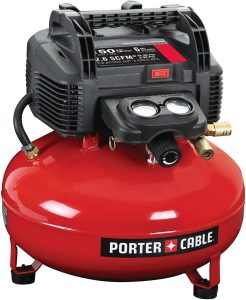
PORTER-CABLE C2002 — 6-Gallon Oil-Free Compressor
- 2.6 SCFM at 90 PSI; 150 PSI maximum tank pressure.
- 120V electric model with two regulated couplers.
- Check tool air demand and allow recovery time.
PORTER-CABLE rates its output at 2.6 SCFM at 90 PSI and maximum tank pressure at 150 PSI. The larger tank stores air for short demands, but its pump delivers less air at 90 PSI than the other two models here.
Do not assume that 2.6 SCFM is sufficient for your impact wrench. Compare the wrench’s consumption and working pressure with the compressor’s output. Lowering the regulator below the tool’s required pressure is not a fix for insufficient compressor capacity.
The manual recommends an average 50–75% duty cycle to prolong compressor life. Thermal-overload protection does not mean the unit never heats up or can supply any tool indefinitely.
The tank drain removes accumulated condensate when used as instructed. Appropriate downstream filtration may also be needed for your tool; a drain or unspecified water separator is not a guarantee of completely moisture-free air.
Pros
- Oil-free pump requires no pump oil changes
- 6-gallon tank and two regulated couplers
- Manufacturer provides operating and maintenance instructions
Cons
- 2.6 SCFM at 90 PSI limits compatibility with air-hungry tools
- Plan for tank recovery and the recommended duty cycle
3. Ingersoll Rand Twin-Stack P1IU-A9
The P1IU-A9 is a 120V electric compressor, not a gasoline-engine model. It uses an oil-lubricated pump with a cast-iron cylinder and a 4-gallon twin-tank arrangement.
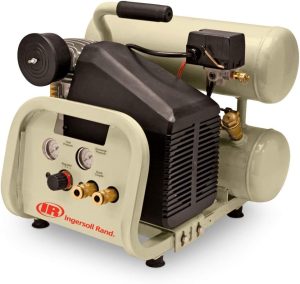
Ingersoll Rand P1IU-A9 — 4-Gallon Twin-Stack Compressor
- 4-gallon twin tank; 135 PSI maximum pressure.
- 120V electric, oil-lubricated model with two couplers.
- 77-pound unit; verify air-tool demand before choosing.
Ingersoll Rand lists 4.3 CFM at 90 PSI for the P1IU-A9; the Amazon listing currently states 3.2 CFM at 90 PSI. Confirm the supplied model’s airflow with the seller before matching it to your impact wrench.
The unit has two quick-disconnect couplers. Using more than one tool still requires enough airflow for their combined demand; two outlets do not double the compressor’s capacity.
Check and fill the lubricant as directed before operation. Supplied lubricant does not mean the pump is ready to run without this check. Follow the manual’s lubricant and maintenance instructions.
An automatic pressure switch controls normal cycling. The motor also has a thermal protector with a manual reset; if it trips, follow the manual’s checks rather than repeatedly restarting the unit.
The manufacturer lists a 77-pound weight. Its compact frame is useful for transport, but the weight and available lifting assistance should be considered before moving it.
Air compressors for automotive air tools
Pros
- 4-gallon twin-tank arrangement
- Two quick-disconnect couplers
- Automatic pressure control and thermal-overload protection
Cons
- 77-pound unit
- Oil-lubricated pump needs lubricant checks and maintenance
- 4-gallon storage and available airflow still limit sustained tool use
The video below demonstrates hose, fitting and regulator changes on a different Craftsman compressor. It is not a test of the models reviewed here or a model-specific upgrade guide. Reducing restrictions in the air line does not increase the pump’s rated airflow. Follow the equipment manuals and pressure limits; do not alter pressure switches, tanks or safety valves.
Choose by the impact wrench’s specified air demand and operating pressure, then account for your usage pattern and the compressor’s instructions. None of these portable models can be assumed to provide unlimited air for every wrench.
Air compressors for painting cars