
A wide belt sander can help a woodworking shop process panels and repeated batches, but “small shop” does not mean a small electrical or installation requirement. Match the machine to your stock, workload, available power, dust collection and floor space before comparing sanding width.
The Powermatic WB-25 below is a genuine industrial wide belt machine. The JET JWDS-1020 appears separately as a compact drum-sander alternative for smaller work; it is not a wide belt sander or a substitute for the same production capacity.
Powermatic WB-25: A Wide Belt Option for an Equipped Shop
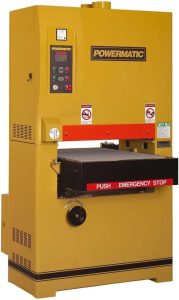
Powermatic WB-25 25-inch Wide Belt Sander
- Model 1790825: 15 HP, three-phase, 230/460V
- 25-inch working width and 25 × 75-inch abrasive belt
- Digital thickness control and variable-speed conveyor
- Requires compressed air, dust collection and professional installation
The WB-25 provides a 25-inch working width, a maximum stock thickness of 6 inches and a minimum board length of 12 inches. Its main drive, conveyor feed and table lift have separate motors. The digital readout and automatic thickness-measuring function help set up repeated work, while the pneumatic system controls belt oscillation. These features still require correct calibration, suitable abrasives and test passes.
The selected 1790825 version has a 15 HP three-phase main motor and is prewired for 230V. It is not a single-phase machine for an ordinary household outlet. Its manual specifies additional components for a 460V conversion, so have the electrical supply and installation checked by a qualified electrician rather than assuming the voltage can simply be switched.
Powermatic’s current WB-series manual specifies two 5-inch dust ports, 800 CFM of dust collection and an air supply regulated to 75–80 PSI for the WB-25. Arrange a suitable collection system and compressed-air source before delivery. A hose that fits the port does not establish that a shop vacuum provides the required extraction.
This is a substantial stationary machine. The manual lists a 53 × 45 × 72-inch overall envelope, before allowing room to feed and remove boards or access the side panels. Plan the delivery route, lifting equipment and a level, sturdy floor. It is a conditional choice for a small professional shop with the necessary infrastructure, not a beginner-friendly portable purchase.
Wide Belt Sander vs. Drum Sander
A wide belt machine carries a broad abrasive loop around its sanding assembly; a drum sander uses abrasive wrapped around a rotating drum. Both can finish wood, and neither guarantees a flawless surface merely because of its design. Feed rate, abrasive condition, alignment and workpiece support affect the result. Ripples are a fault to diagnose, not an unavoidable feature of every drum sander.
JET JWDS-1020: A Smaller Drum-Sander Alternative
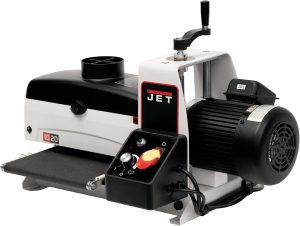
JET JWDS-1020 Benchtop Drum Sander — a Different Category
- Model 723510: 1 HP, 115V, single-phase
- 10-inch single-pass width; up to 20 inches in two passes
- Maximum stock thickness 3 inches
- For wood finishing and light passes, not wide-belt production capacity
The JWDS-1020 is an open-ended benchtop drum sander. It can sand a board up to 10 inches wide in one pass or up to 20 inches in two passes. Its smaller capacity and single-phase electrical requirement may suit work that does not justify an industrial wide belt installation. Compare actual cycle times and finish requirements rather than treating those two-pass dimensions as equal to a 20-inch wide belt machine.
JET specifies a 115V supply and recommends a dedicated 15A circuit, subject to local requirements. Bolt the machine to a suitable bench, provide the specified dust extraction and take light passes. The 4-inch dust port still needs a suitable collection arrangement. This sander is for wood; the separate guide to sanding belts for metal does not make either woodworking machine suitable for metal.
Buying Guide for a Small Woodworking Shop
Start with the Workpiece and Workload
Record the widest panels, shortest pieces, thickness range and batch sizes you actually process. Minimum stock dimensions matter as much as maximum width. Allow appropriate infeed and outfeed support for long boards; an open floor beyond the machine does not mean unlimited unsupported stock length. Ask for a demonstration with representative material before committing to a production machine.
Check Belt Changes and Consumables
Compare the access needed to change an abrasive belt, the available grit sizes and the cost of consumables. Disconnect the energy sources and follow the supplied manual before changing belts or servicing the machine. Easy access is useful, but it does not remove the need for training and correct tension, tracking and alignment.
Treat the Readout as a Setup Tool
A digital display can make repeat settings easier, but it is not the only route to an accurate surface and does not compensate for a poorly adjusted machine. Measure test pieces and choose abrasive and feed settings appropriate to the stock. Do not assume a display alone guarantees a finished thickness under every cutting load.
Budget for Installation and Safe Operation
Include electrical work, extraction, compressed air where required, delivery, rigging and maintenance in the total cost. Train operators, use the guards and emergency controls correctly, and keep hands away from the feed and sanding areas. Plan a fixed working position for a heavy wide belt sander rather than expecting to move it around a crowded shop routinely.
For smaller or different jobs, see our guides to stripping furniture and sanding in tight spaces. Our small-shop CNC guide and drill-press guide cover separate machining tasks.
Choose the WB-25 only if your workload and installation support a true industrial wide belt sander. For smaller wood-finishing jobs, evaluate the JET as a drum sander on its own merits. For an unrelated outdoor wood-processing task, our commercial wood-chipper guide compares a different class of equipment.