
A walk-behind concrete saw with a dust-control connection can help manage dust at the cut. The two models below have different cutting depths and applications; neither should be treated as a saw with a complete powered vacuum included.
Concrete cutting can release respirable crystalline silica. Dust controls reduce exposure, but a dust port does not eliminate the hazard. Follow the saw instructions and the task-specific controls in OSHA’s walk-behind saw guidance.
Match the blade and saw to the material and task. The SKIL model below is a concrete saw, while the Tomahawk is an early-entry saw for contraction joints in green concrete; neither is a universal choice for steel, tile, or deep demolition cuts.
Best walk behind concrete saw with vacuum (preview)
Compare the SKIL SPT79A-10 for corded concrete cutting up to 2 inches deep with the Tomahawk TFS6H for early-entry joints up to 1-3/16 inches deep.
I will introduce you to the best walk behind concrete saw with vacuum in this article and also share some useful tips to help you when shopping for one.
Best walk behind concrete saw with vacuum reviews
Here are two walk-behind models to compare by cutting depth, power source, and the dust-control equipment required for your job.
1. SKIL SPT79A-10 7-inch Worm Drive Walk-Behind Concrete Saw
This corded 15-amp saw has an adjustable walk-behind handle and a 7-inch blade capacity.
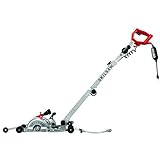
Its worm-drive transmission delivers power to the blade. This is not a variable-speed control for the operator.
SKIL specifies a maximum cut depth of 2 inches with a 7-inch blade and a 7/8-inch arbor.
Check that this cutting depth is sufficient for the concrete work you plan to do.
The adjustable handle folds for storage, and the pointer helps the operator follow the cut line.
The wet/dry dust-management system includes a water-feed assembly and a vacuum-hose adapter. Dry extraction requires a separate suitable dust extractor; the saw does not contain a powered vacuum.
SKIL lists rust-resistant brackets and fasteners, but service life still depends on use and maintenance.
The walk-behind frame and handle allow operation from a standing position; support and control still depend on following the manufacturer’s instructions.
The SKIL specification and included-accessory list identify the saw, dust connections, and blade requirements.
Pros
- 15-amp corded power with worm-drive transmission.
- Adjustable folding walk-behind handle.
- Wet-cutting connection and dry-extraction adapter.
Cons
- Wet cutting requires a water supply; dry extraction requires a separate suitable vacuum.
2. TOMAHAWK 6-inch Early Entry Concrete Walk Behind Saw
The current TFS6H uses a 3.5 HP Honda GX120 engine. It is an early-entry saw for cutting contraction joints in green concrete, rather than a deeper-cutting replacement for the SKIL.

Tomahawk specifies a 6-inch blade and a maximum cut depth of 1-3/16 inches. Check the blade’s arbor compatibility and the concrete’s readiness for early-entry cutting.
Polyurethane wheels are intended for working on fresh concrete. Follow the TFS6H manual for blade changes; our separate zero-turn mower blade-change guide applies to lawn mowers, not this saw.
The lower/raise lever controls engagement of the blade, while the pointer helps follow the intended cut line.
The protective frame and accessible controls are features to consider, but they do not guarantee a particular service life.
The current Tomahawk TFS6H product specifications list the GX120 engine and 1-3/16-inch cutting depth; the older URL still contains the previous engine description.
The dust port is a connection for a separate extraction system. It is not an OSHA approval or a guarantee that silica exposure is controlled; follow the manufacturer’s instructions and the applicable task-specific dust controls.
Pros
- 3.5 HP Honda GX120 engine.
- Designed for early-entry contraction joints.
- Polyurethane wheels and a blade-lowering lever.
Cons
- Limited to 1-3/16-inch cutting depth; requires a separate suitable extraction system.
String trimmer line keeps breaking
Why use a walk behind concrete saw with vacuum
Cutting concrete can release airborne respirable crystalline silica. The risk depends on the task, duration, equipment, and exposure controls.
Now, due to its ultra-fine nature, RCS dust can penetrate deep into your lungs and trigger chronic issues such as silicosis and lung cancer.
A saw with a vacuum connection can collect dust near its source when connected to a suitable extraction system and used as instructed.
The effectiveness of extraction depends on the saw, enclosure, airflow, filtration, and maintenance. A visible reduction in dust is not proof that exposure is below a safe limit.
Types of walk behind concrete saws with vacuum
There are two major variations in these power tools:
1. Gas-powered walk behind concrete saws
A gas-powered concrete walk behind saw delivers tremendous cutting power.
Gas-engine exhaust makes these saws unsuitable for enclosed areas. Follow the engine and saw manuals on operating location and ventilation.
2. Electric walk behind concrete saws
Electric saws vary in power and cutting capacity; compare the specific model rather than assuming that every electric model cuts more slowly than a gas saw.
For example, the corded SKIL here cuts up to 2 inches deep, while the gas-powered Tomahawk is designed for shallower early-entry joints.
Corded saws do not produce engine exhaust at the saw, but they still create noise and dust and require a suitable electrical supply.
Tools to remove thinset from concrete
What to look out for when shopping for a walk behind concrete saw with vacuum
These saws are quite pricey and you don’t want to commit a blunder when choosing.
Here are the features to focus on when comparing these masonry saws:
Cutting Depth
Blade diameter alone does not establish cutting depth. Check the manufacturer’s maximum depth for the exact model: 2 inches for the SKIL here and 1-3/16 inches for the Tomahawk.
Larger walk-behind saws may suit deeper cuts, but require a separate comparison of capacity, blade type, and handling.
I am yet to meet someone who hates versatility in power tools and you, certainly, won’t be the first.
Engine
The engine is key and you must be careful here, lest you end up with an underpowered tool.
Examine these factors:
- Power and application — compare rated power together with blade size, cutting depth, and the material being cut.
- The make– Honda and Briggs &
Stratton engines seem to win favor. - Engine requirements — follow the exact engine manual for fuel, oil, servicing, and operating conditions; do not assume all concrete saws use the same engine type.
Service life depends on correct loading, cooling, maintenance, and operating conditions; a larger power rating alone does not guarantee longer life.
User friendliness
You ultimately want a tool that’s user friendly and hence a breeze to use/maintain.
Look for features that permit fast blade replacement and access to various parts.
A straightforward raise/lower system (for the blade), vibration dampeners, and soft grip handles all help deliver a smoother cutting experience.
A longer power cord is also great as is enhanced maneuverability.
Overall construction
You’re paying a decent amount of money and you want a tool that holds up.
This means that features like quality craftsmanship, strengthened housing/frame, and rust-resistant materials will interest you.
Walk behind dethatcher machines reviews.
Safety considerations
You might occasionally be working on fresh concrete and you don’t want a tool that causes damages so additions like polyurethane wheels come top of your list.
In addition, you may want oversized wheels to boost general stability.
Storage and transport
A compact unit takes up less space and will be easier to bring to the jobsite.
Besides, an adjustable, folding handle helps make transport
and storage less stressful.
Blades
Use the blade type specified for the saw and the material. Early-entry concrete blades and general concrete-cutting blades are not automatically interchangeable.
Follow the blade and saw instructions for wet or dry operation and water supply, rather than assuming one blade always needs less water.
Also, check the arbor size- you want one that fits the blade sizes you typically use snugly, again for safety reasons.
Other ways to mitigate against airborne dust
Implement the following tricks to further reduce the dust:
- For wet cutting, use the saw’s water-delivery system as instructed to feed water continuously to the blade. Treat slurry and cleanup as part of the job; see also our concrete-floor thinset-removal guide.
- Use the task-specific dust controls required for the job. General ventilation alone is not a substitute for effective silica control.
- Use the eye, hearing, and other protection specified for the work, including properly selected respiratory protection where required.
A vacuum connection is useful, but buying a saw with a dust port is only one part of controlling exposure during concrete cutting.
Of course, your target is to get one that suits all you concrete cutting needs and I have included tips to help you select.
Whatever your choice, don’t forget to observe the other mitigation measures when on the jobsite.