Oak, maple and birch trees can leave a large cleanup job in fall. A walk-behind leaf blower moves leaves into piles while its wheels carry the engine and blower housing. You still have to push, steer and control the machine.
The Landworks model below is a gas-powered option for open lawn and garden work. Before choosing a wheeled blower, compare the width of your paths, terrain, storage space and local noise rules. A powerful machine is useful only if you can handle it comfortably and use it in the intended area.
Landworks Walk-Behind Leaf Blower
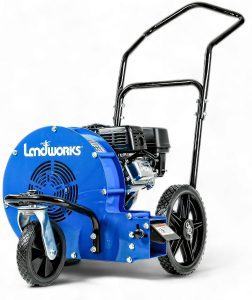
Landworks Gas Walk-Behind Leaf Blower
- Manual-propelled wheeled blower for lawn and garden cleanup
- Four-stroke OHV gas engine
- Steel housing and metal impeller
- Swiveling front wheel and adjustable airflow direction
This Landworks blower gathers leaves and similar yard debris into piles. Its four-stroke OHV engine drives the impeller, while the operator pushes the machine rather than relying on a self-propelled transmission. It is a blower, not a vacuum with a collection bag.
A swiveling front wheel helps with turning, and the adjustable airflow direction lets you direct the discharge toward your cleanup area. Leave enough room to maneuver around beds, parked vehicles and narrow paths. Wheels make it unnecessary to carry the machine, but they do not make rough ground or slopes effortless.
The steel housing has a rust-resistant coating. That is not a reason to store the blower outside in rain: clean it after use and follow the storage instructions. Engine oil is not included with the selected listing, so complete the specified oil and fuel checks before starting it.
Check the exact engine label and supplied manual when the machine arrives. Product revisions can change engine and impeller specifications; match replacement parts and service instructions to the machine itself rather than assuming that a similar-looking model is identical.
Strengths: Wheeled support, directional airflow and a metal housing for larger leaf-moving jobs. Limitations: Manual pushing, gas-engine maintenance, noise and storage needs; it does not collect or shred the leaves it moves.
Related: Walk-behind dethatchers
Choosing a Walk-Behind Leaf Blower
Blowing, vacuuming and chipping are different jobs
A blower moves material to another location. A lawn vacuum collects it, usually into a bag, and a chipper has a specified inlet for branches. Do not feed branches into a blower or assume that a vacuum’s pickup width measures its blowing performance.
If your main task is collecting leaves rather than moving them, compare a purpose-built lawn vacuum. For areas where a wheeled machine is awkward, a backpack leaf blower is another format to consider. A leaf pusher for a zero-turn mower has different vehicle and mounting requirements.
Airflow and engine specifications
Air volume and air speed describe different aspects of a blower. Compare figures measured for the exact model, alongside its controls and discharge arrangement. Engine displacement alone does not establish how quickly a blower will move wet leaves or how easy it will be to handle.
Use a blower only for debris and conditions permitted by its instructions. Remove rocks and loose objects that could become projectiles. Do not assume that a leaf blower is also approved for sand, snow or branch processing.
Weight, wheels and access
Check the full machine dimensions, usable route and storage opening. Manual propulsion still requires effort, especially when starting, turning or crossing uneven ground. Follow the manufacturer’s terrain limits and avoid areas where you cannot keep control of the machine.
Engine care and operation
Follow the specific fuel and oil requirements. Four-stroke engines normally have a separate oil supply; do not add a two-stroke fuel mixture unless the engine instructions call for it. Stop the engine and let it cool before refueling, and never run a gas engine inside a building or other enclosed space.
Keep bystanders clear of the discharge. Use the eye and hearing protection specified in the manual, and observe local operating hours. Ear protection helps protect the operator; it does not reduce the noise reaching neighbors.
Choosing a Leaf Blower Type
The video below is Troy-Bilt’s general guide to choosing a leaf blower. It discusses another manufacturer’s equipment, not a test of the Landworks model above or a guarantee of the same specifications.
Plan the Cleanup Before Buying
Decide where leaves will be collected and how you will dispose of them after blowing. Avoid directing debris toward people, roads or neighboring property. If your yard is small or has many tight spaces, a large wheeled machine may be less convenient than a smaller tool.
For larger open areas, the Landworks is an option to compare when manual pushing and gas maintenance suit your needs. Choose by the actual terrain and task rather than an unsupported claim that one blower is the most powerful or suitable for every surface.
See more home and garden equipment guides for other projects.
Related: Small gas chainsaws for separate cutting tasks
Related: Generator power for electronics