
A tow-behind dethatcher can help remove excess thatch when your lawn needs it. The three attachments below require a suitable riding mower or lawn tractor with an approved towing hitch.
Their wider working paths can cover larger areas than a hand rake, but they also need room to turn and a towing vehicle that can handle the load.
We have prepared this guide to help you choose a dethatcher attachment for lawn mower to help you take charge of this essential lawn care task.
This comparison covers the 40-inch Brinly DT-402BH-A, the 48-inch Agri-Fab 45-0295 and the 40-inch Agri-Fab 45-0294. Check hitch compatibility, working width and storage space before choosing.
We shall also be commenting on the question of how to time your dethatching task.
Read on.
Best dethatcher attachment for lawn mower: product reviews
Below are three tow-behind options, with their main differences and fitting requirements.
They loosen thatch for collection; none guarantees a healthy lawn without appropriate timing, adjustment and follow-up care.
Take a look:
1. Brinly DT-402BH-A Tow-Behind Dethatcher (40-Inch)
The Brinly DT-402BH-A uses spring tines across a 40-inch working width. It offers dethatching, scarifying and transport settings for different stages of the job.
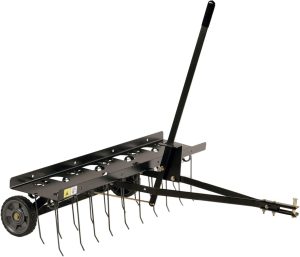
Brinly DT-402BH-A 40-Inch Tow-Behind Dethatcher
- 40-inch working width; 20 spring-steel tine tips.
- Dethatch, scarify and transport settings.
- Maximum 70 lb added ballast; requires a suitable approved towing hitch.
Two rows provide 20 independently flexing spring-steel tine tips. They lift thatch toward the surface for collection. For a separate mower-maintenance task, see our guide to replacement lawn-mower pull cords.
The three settings change how the tines engage with the surface.
In dethatching mode, the tines flex and flick thatch upward. Adjust the unit so it works at the intended depth rather than dragging too deeply.
Scarify mode scrapes the soil surface more aggressively and can help prepare for reseeding. It does not turn the attachment into a rotary tiller or core aerator.
Transport mode lifts the tines for crossing drives and walkways. Stop the towing vehicle safely before making adjustments.
The steel tray accepts a maximum of 70 pounds of additional ballast. Start with the correct height adjustment; add only the weight needed, secure it and account for it in the towing vehicle’s load limit.
The drawbar adjusts for hitch heights from 7 to 14 inches. Confirm the approved hitch point, clearance and towing limits on your particular vehicle.
Pros
- 40-inch working width and three settings.
- Transport wheels lift the tines clear of paving.
- Tines arrive pre-assembled to the tray; remaining assembly is required.
Cons
- Requires a compatible towing vehicle and careful height adjustment.
- Lifted thatch still needs to be collected.
2. Agri-Fab 45-0295 Tine Tow Dethatcher(48-Inch)
The Agri-Fab 45-0295 has a 48-inch working width, making it the widest attachment in this comparison.
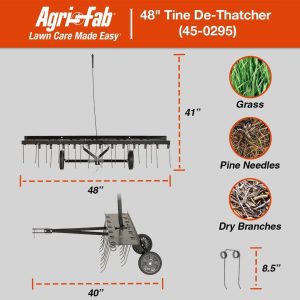
Agri-Fab 45-0295 48-Inch Tow-Behind Dethatcher
- 48-inch working width with 24 spring-tine tips.
- Cantilever transport handle and semi-pneumatic wheels.
- Maximum 70 lb added ballast; check tow-vehicle limits.
It covers eight inches more per pass than either 40-inch model. Check that the wider tray fits your gates, turns and storage area.
There are 24 replaceable spring-tine tips and two semi-pneumatic wheels. Clean and dry the attachment after use and touch up damaged paint; the tines should not be treated as permanently rust-proof.
A cantilever transport handle raises and lowers the tines. Set the front and rear rows to contact the ground evenly, following the manual.
The tray has a 70-pound maximum ballast capacity. This is a limit, not an instruction to load it fully. Secure any required weight and stay within the towing vehicle’s limits.
Pros
- 48-inch working width.
- Replaceable spring-tine tips.
- Semi-pneumatic attachment wheels. For mower-tire options, see our separate flat-free tire guide.
Cons
- The wider tray needs more turning and storage clearance.
3. Agri-Fab 45-0294 Tine Tow Dethatcher (40-Inch)
The Agri-Fab 45-0294 offers a 40-inch working width for yards where the wider 45-0295 would be awkward to maneuver or store.
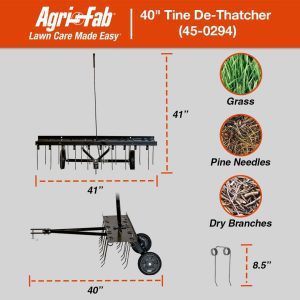
Agri-Fab 45-0294 40-Inch Tow-Behind Dethatcher
- 40-inch working width with 20 spring-tine tips.
- Transport handle; hitch pin included.
- Requires a compatible lawn or garden tractor approved for towing.
It has 20 replaceable spring-tine tips that lift thatch from the turf. It is not intended to uproot weeds or excavate soil, and setting it too deep can damage the lawn.
Its working width matches the Brinly DT-402BH-A. Like the wider Agri-Fab, it uses a cantilever transport handle to raise and lower the tines.
Handle access depends on your towing vehicle. Stop safely before adjusting it; do not assume it can be reached from every mower seat.
The two semi-pneumatic wheels support transport, but rough ground, tight turns and slopes still require caution and the limits in both equipment manuals.
A hitch pin is included. Confirm that the mower permits towing and that its hitch and load limits suit this attachment, including any added ballast.
Pros
- 40-inch width takes less lateral space than the 48-inch model.
- 20 replaceable spring-tine tips.
- Transport handle and included hitch pin.
Cons
- Assembly and leveling are required before use.
Plows for garden tillers reviews
What is a dethatcher attachment for lawn mower
A tow-behind dethatcher uses spring tines to loosen excess thatch for removal. Correct height and timing matter: aggressive passes can also damage living grass.
Tine count and working width vary by model. Replace worn or broken parts with the manufacturer’s specified replacements.
Raise or lower the tines using the model’s adjustment and transport controls, following its manual.
Best tow behind dethatcher buying guide
To avoid blundering, it’s important to keep the following at the back of your mind when shopping for a dethatcher attachment:
· Effectiveness
Choose the attachment for the amount of thatch and the lawn’s condition. A spring-tine rake may not provide the same action as a powered vertical mower.
Depth adjustment helps control the tine contact. Start with the manufacturer’s setting and check a small area; deeper is not automatically better.
Consult the manufacturer’s manual for setup and operating limits. User reviews can add ownership context but do not establish compatibility with your mower.
· Ease of use
Check how much assembly and leveling the attachment requires before first use.
Pre-assembled tines reduce one assembly step, but the tow bars, handle and wheels may still need fitting.
A transport setting helps move between lawn areas without dragging tines across hard surfaces.
Check the controls and hitch clearance on the actual towing vehicle, and stop before adjustments.
· Durability
Look for replaceable wear parts and clear maintenance instructions.
Steel construction still needs cleaning, dry storage and attention to paint damage and loose fasteners.
· Dethatching width
A wider working path covers more ground on each straight pass, but can be less convenient around obstacles.
Measure narrow access points and the available turning and storage space.
For a large lawn, balance width against access and the towing vehicle’s limits. If buying is impractical, compare suitable dethatcher rental options; powered rental machines may operate differently from these tow-behind attachments.
How to connect a dethatcher attachment for lawn mower
Read both the attachment manual and the towing vehicle manual. Use only a hitch point approved for towing and confirm the vehicle’s towing and drawbar limits.
Fit the specified hitch pin and retaining clip, then level the attachment as directed. A pin supplied with the attachment does not make it compatible with every mower.
Do not drill or modify a mower to make one of these attachments fit, and do not assume a walk-behind mower can tow it. Our guide to drilling fence-post holes in rocky soil covers a different job, not mower modification.
Check the connection, fasteners and any safety wires specified in your model’s manual before use. Added ballast must be secured and included in the total towed weight.
Removing excessive thatch can improve access for water and air, but the lawn still needs suitable growing conditions to recover.
Box scraper for riding lawn mower reviews
Choose the width and adjustment features that suit the lawn, then confirm the mower’s compatibility before ordering.
That being said, it’s important that you dethatch at the most appropriate time for the best outcome.
Dethatch when the grass can recover actively, using local guidance for your species and climate. Early autumn is often suitable for cool-season grass, while late spring or early summer can suit warm-season grass such as zoysia. Avoid treating one calendar date as suitable for every lawn.