
The right machine for removing rocks depends on whether you are dealing with loose surface stones, buried rocks or boulders. A rake can gather material into a windrow; a grapple can lift suitable loose material; a box blade primarily reshapes soil and gravel. These are different jobs, and none of the attachments below automatically leaves a lawn free of every stone.
Start by checking rock size, access, ground conditions and the machine you already own. For a small patch, hand collection may cause less disruption than a tractor attachment. Large embedded rocks may require a contractor with appropriately sized excavation and lifting equipment.
Machine to Pick Up Rocks in a Yard: Your Options
Rake Attachments
Landscape rakes can gather loose surface stones and debris on suitable ground. They normally move the material rather than load it into a collection hopper, and their tines can disturb soil or turf. Match the working width, tine spacing, hitch and ground-engaging capability to your vehicle.
1. Agri-Fab 45-0366 Sleeve-Hitch Rock Rake
The Agri-Fab 45-0366 is a 48-inch sleeve-hitch rake with heat-treated steel tines. It is an example of a ground-engaging attachment for scraping and leveling loose or lightly compacted dirt and gravel. It does not attach to an ordinary mower drawbar just because the mower can pull a trailer.
Its supplied manual and the tractor’s sleeve-hitch instructions determine attachment and operating limits. The rake can be angled for windrowing or reversed for pushing suitable loose material. Do not use that adjustment as a promise that it can dislodge oversized buried rocks. Drive slowly and respect the vehicle’s stability limits.
2. Black Boar 66002 Landscape Rake
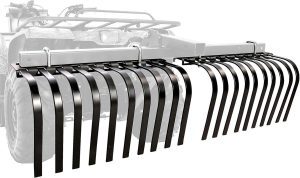
Black Boar 66002 Landscape Rake
- ATV/UTV landscape-rake attachment
- Removable tines allow spacing adjustment
- Requires a compatible Black Boar lift, sold separately
- Greyed equipment in the image is not included
The Black Boar 66002 has removable tines, allowing their spacing to be adjusted for the material being raked. Removing tines changes what can pass between them; it does not turn the attachment into a boulder excavator or guarantee that all rocks will be gathered in one pass.
It requires a compatible Black Boar motorized lift 66000 or manual lift 66013, sold separately. Check the lift’s two-inch receiver requirement and your ATV/UTV’s capacity before ordering. The greyed lift or vehicle components shown in the product image are not included with the rake.
A three-point landscape rake uses a different mounting arrangement. Do not assume its fitting instructions apply to this receiver-mounted system. A passenger trailer is also a separate type of ATV accessory, not a compatibility guide or an approved rock-hauling attachment.
Equipment for Grading and Handling Larger Material
After loose stones are gathered, loading and moving them is a separate task. For embedded boulders, assess the excavation and lifting requirements before selecting an attachment. Do not substitute a small grading implement for equipment with the necessary capacity.
1. Box Blade: Grading Rather Than Boulder Lifting
A box blade can loosen suitable soil and gravel with its scarifier teeth and then grade the surface. It does not lift rocks into a hopper or safely push any boulder that happens to be in its path.
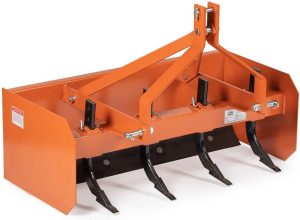
Titan 4-Foot Box Blade Scraper
- Selected 4-foot version with four scarifier teeth
- Pin-style three-point hitch; confirm tractor compatibility
- For grading, light ripping and backfilling—not lifting boulders
The selected Titan version is the four-foot box blade, with four scarifier teeth. Titan describes this type of attachment for light-duty ripping, finish grading and backfilling. Check the exact size and hitch details when ordering; specifications for the larger models in the same product family do not describe the four-foot version.
It uses a pin-style three-point connection. Confirm the tractor’s hitch category, lift capacity, ballast and implement limits against the actual attachment instructions. A suitable hitch alone does not establish that the tractor can handle every load or ground condition.
Related: Box scrapers for lawn tractors and their hitch requirements
2. Root Grapple: Grasping Loose Material
A root grapple has hydraulic jaws for grasping material. It is not the same machine as a powered landscape rake that feeds stones into a hopper, and it should not be described as a universal Bobcat attachment.
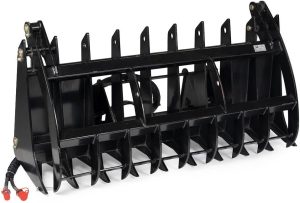
Titan 72RAKEv2 Root Grapple Rake
- 72-inch clamshell grapple attachment
- Universal skid-steer-style quick attach (SSQA)
- Twin hydraulic cylinders; requires compatible loader hydraulics
- For grasping suitable loose material—not a powered collection rake
The Titan 72RAKEv2 is a 72-inch clamshell root grapple with a universal skid-steer-style quick-attach connection and twin hydraulic cylinders. It can hold appropriate loose rocks, brush and other bulky debris, subject to the attachment and loader limits. It does not automatically separate small stones from soil.
Verify the loader mount, auxiliary hydraulic connections and operating requirements with the supplier. Account for the attachment’s own weight when assessing the remaining lifting capacity, and follow the loader’s limits for reach, height and stability. The hydraulic cylinder pressure is not a statement of how much rock the machine can safely lift.
Other skid-steer attachments, such as log splitters, have their own hydraulic and mounting requirements. Sharing an attachment category does not prove compatibility. For lighter work, compare tow-behind rakes with the capabilities of the towing vehicle.
Other Equipment Options
The geological type of rock is only one consideration. Size, burial depth, weight and safe access determine whether ordinary yard equipment is suitable.
- Backhoe or excavator: Can expose and move appropriately sized buried material when operated within the machine’s digging and lifting limits. Large rocks, buried services and difficult access require professional assessment.
- Purpose-built rock picker: Collects stones within its specified size range, often separating some soil as it loads them. Soil condition, field preparation and the manufacturer’s limits matter.
- Rock-digging equipment: A broad category, not a single machine with unlimited capacity. Select a specific attachment and carrier for the excavation and handling task.
Related: Picking up sticks in a yard
Practical Safety Checks
- Read the carrier, hitch and attachment instructions together. Confirm all required mounting parts and hydraulic components before use.
- Check working capacity, attachment weight, ballast and ground conditions. Engine power alone does not establish safe lifting or towing capacity.
- Keep bystanders clear, use the specified protective equipment and stop before inspecting or clearing an attachment. Never work under unsupported raised equipment.
- Before digging, have buried utilities located and assess whether the task needs a qualified contractor. Do not use an attachment to force out a rock beyond its intended capability.
Related: Snow rakes for solar panels—a different cleanup task
Choosing a Suitable Approach
Use a rake for appropriate loose surface material, a box blade for grading, and a compatible grapple for grasping and moving material within its limits. For large or buried rocks, renting appropriate equipment with a trained operator may be more sensible than buying an attachment that does not match the job.
Video: an FFC powered landscape rake on a Mustang skid steer preparing a yard. This is a different machine from the Titan grapple and Black Boar rake above, not their operating guide.
Related: Ways to pick up acorns